

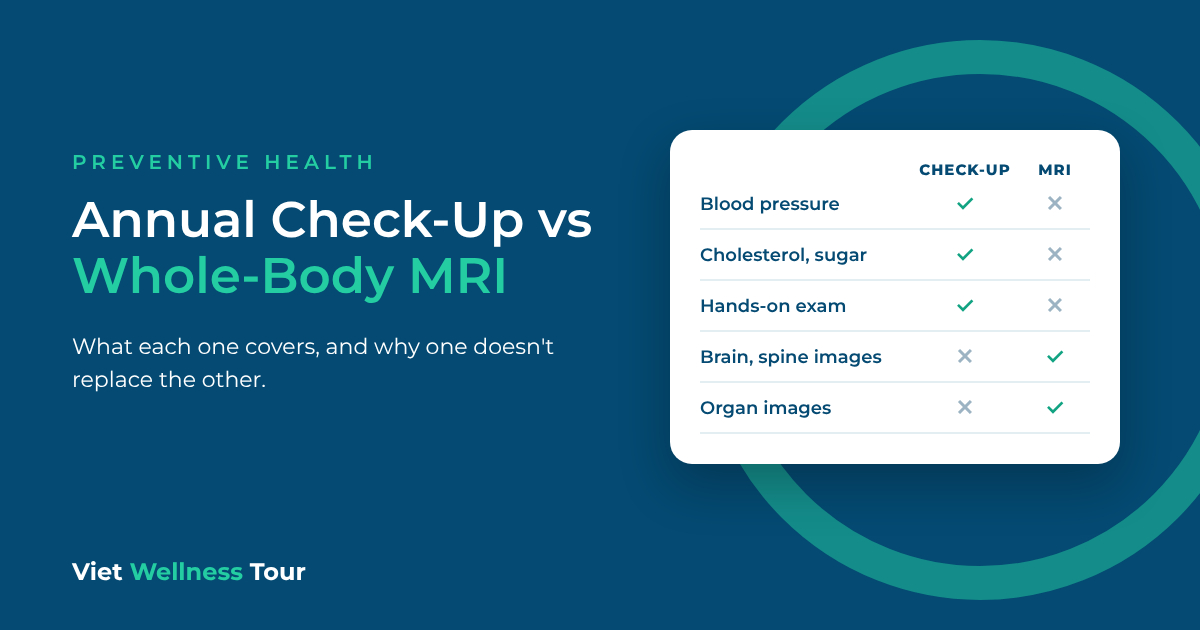
An annual health check up shows how your body is working right now: blood pressure, weight, a hands-on exam and usually blood tests for things like cholesterol and blood sugar. A whole-body MRI shows what your organs and tissues look like inside. They answer different questions, so one doesn't replace the other. They work alongside each other, not as substitutes.
It's a fair thing to wonder about, though. If you already see a doctor every year, is an MRI just more of the same? And if you've had a clear scan, can you skip the yearly visit? The short answer to both is no. The longer answer comes down to what each one actually looks at.
What an Annual Health Check Up Usually Includes
A yearly check-up starts with a conversation. Your doctor asks about your health history, any changes since last time and anything that's been bothering you. Then come the basics: vital signs, height and weight (1).
The physical exam follows. According to Cleveland Clinic, the doctor checks your skin, eyes, ears, nose and mouth, listens to your heart and lungs, examines your abdomen and looks at your nervous system and mental health (1). Depending on your age and sex, it may also include a breast, prostate or genital exam.
Many doctors also order routine blood tests, such as cholesterol and blood sugar. What gets ordered depends on your age, your risk factors and where you have the check-up.
Two of these checks carry particularly strong evidence:
Blood pressure. The U.S. Preventive Services Task Force (USPSTF) gives screening for high blood pressure in adults 18 and older its top "A" grade. It suggests checking every year from age 40, and every 3 to 5 years for younger adults with normal readings and no extra risk (2). Most people with high blood pressure have no symptoms, so measuring it is the only way to know (3).
Blood sugar. The USPSTF recommends screening for prediabetes and type 2 diabetes in adults aged 35 to 70 who are overweight. For Asian Americans, it suggests a lower BMI threshold of 23 (4). If you're of Asian descent, it's worth asking your own doctor which threshold applies to you.
The check-up is also when your doctor flags other screenings that are due for your age, such as a mammogram, a Pap test or colorectal cancer screening.
What a Whole-Body MRI Shows
A whole-body MRI uses a strong magnet and radio waves to build detailed pictures of the inside of your body. There's no X-ray radiation involved, which our guide on whether MRI uses radiation explains in more detail.
Protocols vary between providers. The Viet Wellness Tour full-body MRI runs from head through pelvis in one structured session: the brain, head and neck, chest, heart and major vessels, the abdominal organs, the pelvis and the spine. Radiologists look for structural changes, things like cysts, masses or wear in the spine, that a stethoscope or a blood test can't show. The scan itself takes roughly an hour; How Long Does a Whole-Body MRI Take? breaks down the timing.
What you get afterwards is an imaging report. If you're curious what the wording means, How to Read Your MRI Report walks through the common terms.
Whole Body MRI vs Health Check: Side by Side
What it covers | Annual health check up | Whole-body MRI |
|---|---|---|
Blood pressure and heart rate | Yes | No |
Cholesterol and blood sugar | Yes, with blood tests | No |
Weight and BMI | Yes | No |
Hands-on exam (skin, heart and lung sounds) | Yes | No |
Detailed images from head through pelvis | No | Yes |
Radiation | None | None |
Usual payment | Often covered, depending on your plan | Usually self-pay (more on insurance) |
Put simply, the check-up measures function and risk factors. The MRI looks at structure. Very little overlaps.
What a Whole-Body MRI Doesn't Replace
This part is worth being clear about. A whole-body MRI isn't a substitute for the screenings your doctor recommends.
Christopher Hess, chair of radiology at UC San Francisco, put it plainly: people who choose a whole-body scan "should also be undergoing medical society recommended screenings at appropriate ages and intervals" (5). He also points out that different body areas, the lungs among them, need different MRI techniques for the best view (5). A general screening scan isn't tuned for every organ, which is why a lung finding on MRI may still need a CT scan to follow up.
Professional bodies are cautious too. In 2023, the American College of Radiology said it doesn't believe there's enough evidence to recommend total body screening for people with no symptoms, risk factors or family history of disease (6). Part of its concern is non-specific findings that lead to follow-up tests without improving health (6).
None of that makes the scan pointless. It means the MRI adds a layer on top of standard care rather than replacing it.
Is a Health Check Up Enough on Its Own?
For many adults, a regular check-up plus the screenings recommended for their age covers the essentials of preventive health screening. That's the foundation, and it shouldn't be skipped.
Some people choose to add a whole-body MRI on top. Common reasons include:
A family history that makes them want a closer look
Wanting a baseline picture of the brain and spine to compare against later
A busy schedule that makes one longer visit easier than several appointments (see how this fits an executive health check)
Simple peace of mind, especially from midlife onwards
Whether it makes sense for you is a good question to bring to your own doctor. And if you already have symptoms, that's a different situation: see a doctor first, since a screening scan isn't the right tool for working out what's causing a problem. Our article on preventive health screening in Vietnam and Is a Whole-Body MRI Worth It? go deeper on the trade-offs.
Combining a Whole-Body MRI and Blood Tests in Vietnam
A whole-body MRI won't stand in for your yearly check-up, but if you're visiting Vietnam it's easy to add one to the trip. With Viet Wellness Tour, you choose a Standard (1.5T) or Premium (3T) whole-body MRI at a partner hospital, and you can add a blood test panel if you'd like. An English-speaking guide meets you at the agreed point and helps with check-in on scan day.
Results arrive by email within 24 to 48 hours of the scan, subject to the hospital's reporting schedule. You receive an official MRI report in English, a written medical summary from the doctor, your lab results and a digital copy of your images. Take them to your own doctor at your next check-up, so the two halves of the picture end up in one place.
Viet Wellness Tour arranges screening in Ho Chi Minh City, Ha Noi, Da Nang and Nha Trang. See how it works on the MRI Concierge Journey page, or send the team a message to plan your visit.
Frequently Asked Questions
Is a whole-body MRI better than an annual health check up?
Neither is better. They look at different things. The check-up measures blood pressure, blood sugar, cholesterol and more; the MRI shows detailed images of your organs and tissues.
Does a whole-body MRI check blood pressure or cholesterol?
No. Those need a blood pressure reading and blood tests, which is one reason the yearly check-up still matters.
Is a health check up enough?
For many adults, a regular check-up plus the screenings recommended for their age covers the essentials. Some choose to add a whole-body MRI for a more detailed look. It's worth discussing with your doctor.
Can you do a whole-body MRI and blood tests on the same trip to Vietnam?
Yes. With Viet Wellness Tour, a blood test panel can be added to your MRI booking. Results are sent by email within 24 to 48 hours of the scan, subject to the hospital's reporting schedule.
Sources
Cleveland Clinic, "Physical Examination", last updated April 14, 2023. https://my.clevelandclinic.org/health/articles/physical-examination
U.S. Preventive Services Task Force, "Hypertension in Adults: Screening", Final Recommendation Statement, April 27, 2021. https://www.uspreventiveservicestaskforce.org/uspstf/recommendation/hypertension-in-adults-screening
Centers for Disease Control and Prevention, "About High Blood Pressure". https://www.cdc.gov/high-blood-pressure/about/index.html
U.S. Preventive Services Task Force, "Prediabetes and Type 2 Diabetes: Screening", Final Recommendation Statement, August 24, 2021. https://www.uspreventiveservicestaskforce.org/uspstf/recommendation/screening-for-prediabetes-and-type-2-diabetes
Orenstein B.W., "Looking for Trouble?", Today's Geriatric Medicine, Vol. 17 No. 4, July/August 2024. https://todaysgeriatricmedicine.com/archive/JA24p20.shtml
American College of Radiology, "ACR Statement on Screening Total Body MRI", April 17, 2023. https://acr.org/Media-Center/ACR-News-Releases/2023/ACR-Statement-on-Screening-Total-Body-MRI
Medical disclaimer: This article is for general information only and is not medical advice. Please talk to your own doctor about which check-ups and screenings are right for you.
Details in this article reflect the MRI Concierge Journey process as of November 2026. Steps, packages and policies may change over time; please check with Viet Wellness Tour directly for the most current information.
VIETWELLNESS TOUR
Plan Your Full-Body MRI
Doctor-led preventive MRI screening in Ho Chi Minh City, Nha Trang, Da Nang, and Ha Noi.
- Senior radiologist-led MRI review
- Hotel pickup & English-speaking concierge
- Results in 24–48 hours + full MRI files & report
