

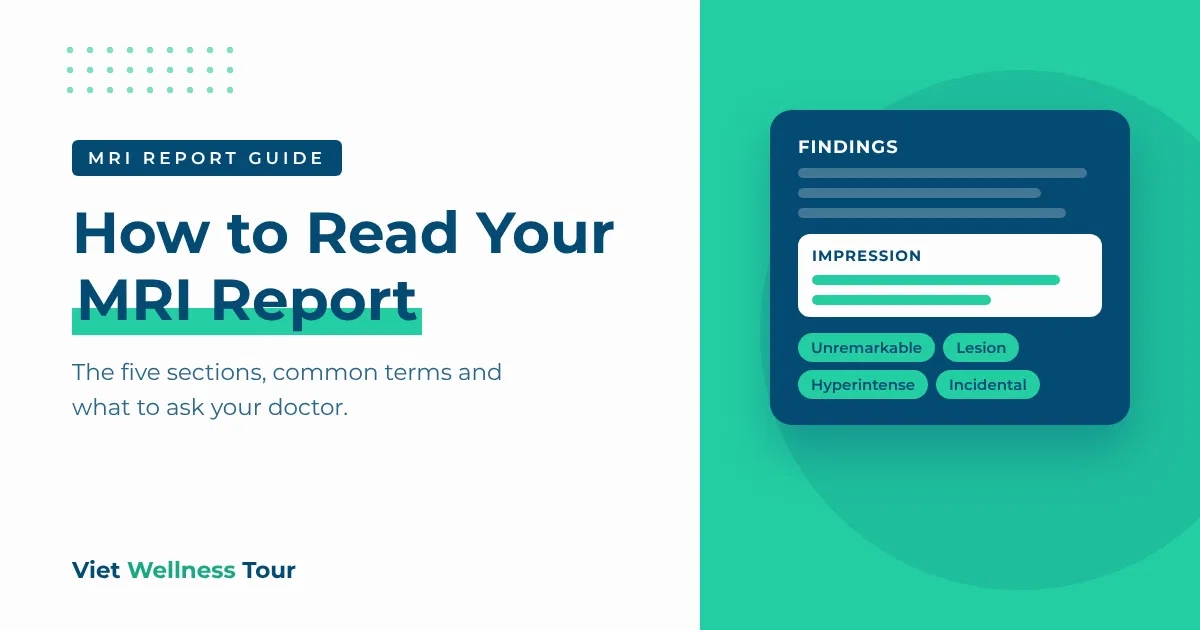
To read MRI results, start at the end. The Impression section is the radiologist's summary of what matters most. The Findings section above it goes through each body area in detail. Most of the words you'll see there, like unremarkable, lesion or hyperintense, describe how the image looks. They aren't a diagnosis on their own.
That's worth knowing before you open the PDF. An MRI report is written by one doctor for another, so it's dense, cautious and full of shorthand. Once you know the structure and a dozen or so common terms, it gets a lot less intimidating.
What Does an MRI Report Say? The Five Main Sections
Reports vary a little between hospitals, but most follow the same order (1).
Exam type and reason
The date, the scan that was done and why.
Technique
How the scan was performed, including the sequences used and whether contrast dye was given. It's mostly there for documentation. You can skim it.
Comparison
Whether the radiologist had earlier scans to compare with. If this says "none", any small finding is being seen for the first time, which is one reason old reports are so useful (more on that below).
Findings
This is the long part. Organ by organ, the radiologist notes what looks normal, what looks abnormal and what might be.
Impression
This is the summary. RadiologyInfo, the patient site run by the Radiological Society of North America and the American College of Radiology, calls it the most important part of the report for you and your doctor (1). If a finding needs action, it'll be here, often with a suggested next step.
How to Read MRI Results: Common Terms and What They Mean
Unremarkable
Good news, despite how it sounds. Unremarkable means the area looks normal and nothing concerning was seen (1). "Within normal limits" means much the same thing.
Lesion
A lesion is a broad, informal word for any area of tissue that looks different from normal (2). That's it. A lesion could be a harmless cyst, a scar, an old injury or something that needs a closer look. The word alone tells you very little, so read what comes next: its size, its appearance and what the radiologist thinks it most likely is.
Hyperintense, hypointense and isointense
These describe brightness. On an MRI image, signal intensity is simply how bright or dark an area looks (2). Hyperintense means brighter than the tissue around it, hypointense means darker, and isointense means about the same.
You'll often see them paired with T1 or T2, which are two common types of MRI image. Each one shows tissues differently, so radiologists compare the same spot across several image types (2). A bright spot on its own isn't a diagnosis. Fluid, fat and many harmless structures can look bright too.
White matter hyperintensities
A specific version of the above that turns up a lot on brain scans. These are small areas in the brain's white matter that look brighter than the surrounding tissue, often on T2 or FLAIR images. Mayo Clinic notes that they're common by midlife, seen in many older adults and often linked to age related changes in the brain's tiny blood vessels (3).
Enhancement
If you had contrast dye, you might read that something "enhances". It means the area got brighter after the dye was injected (2). Radiologists look at whether and how a spot enhances to help tell different kinds of tissue apart.
Cyst, mass and edema
A cyst is a sac filled with fluid. A mass is any unexpected growth or area of extra tissue. Edema is swelling caused by fluid building up (2). Each of these words describes what the radiologist sees; what it means depends on the size, location and appearance noted next to it.
Degenerative changes
This phrase describes wear in the discs and joints of the spine, and it becomes more common with age. A large review of lower back imaging in people with no back pain found disc degeneration in 37% of 20 year olds and 96% of 80 year olds. Disc bulges went from 30% to 84% across the same ages (4). In other words, these changes are often part of getting older. Whether they matter is something to discuss with your doctor, especially if you have symptoms.
Incidental finding
An incidental finding is something the radiologist noticed that wasn't related to the reason for the scan (1). RadiologyInfo puts it plainly: many incidental findings will cause you no harm (1).
For context, a 2018 review in The BMJ pooled studies of MRI in apparently healthy adults. Potentially serious incidental findings came up in about 1.4% of brain scans and around 4% of scans covering both the brain and body, though estimates varied widely between studies. Among those with a known final diagnosis, about one in five (20.5%) turned out to be serious (5). So most flagged findings aren't serious, but some are, which is why the next step matters.
What "Clinical Correlation Recommended" Means on an MRI Report
Radiologists only see images. They don't see you, your symptoms or your blood tests. That's why reports lean on careful wording.
"Clinical correlation recommended" means the finding should be weighed against your symptoms, history or lab results to decide whether it matters (1). It's a note to your doctor, not a warning that something is wrong.
"Cannot be excluded" or "cannot be ruled out" means the radiologist can't say for certain from the images alone. Words like "likely", "probably" and "consistent with" show how confident they are. "Nonspecific" means the finding could have several explanations. None of these phrases should be read as a diagnosis, good or bad.
"Follow-up recommended" is different. If the Impression suggests another scan or a specialist review, take that to your doctor and agree on a plan rather than letting it sit.
Questions to Ask Your Doctor About Your MRI Results
A report makes more sense in conversation with a doctor who knows your history. A few questions help:
What's the most important thing in the Impression?
Does anything here need follow-up, and how soon?
Could this finding be related to any symptoms you have?
Would an earlier scan help to compare?
On that last point, keep every report and image copy you're given. Earlier scans give the radiologist something to compare against.
MRI Results: How Long They Take and What You Receive
How long MRI results take depends on the hospital. With Viet Wellness Tour, results arrive by email within 24 to 48 hours of the scan, subject to the hospital's reporting schedule. Our guide to how long a whole-body MRI takes breaks down the timing.
Your results include an official MRI report in English, written after a doctor has read and analyzed your images, plus a written medical summary from the doctor explaining the findings. Blood test results come too if you added a panel, along with a digital copy of your images to share with your own doctor at home.
Still deciding whether screening suits you? Is a Whole-Body MRI Worth It? and Whole-Body MRI for Cancer Screening cover the benefits and limits.
Get Your MRI Report in English With Viet Wellness Tour
Viet Wellness Tour arranges MRI screening for foreigners and overseas Vietnamese in Ho Chi Minh City, Ha Noi, Da Nang and Nha Trang. Choose a Standard (1.5T) or Premium (3T) scan at a partner hospital, with an English-speaking guide beside you on scan day. Your English report and written summary follow by email within 24 to 48 hours of the scan.
See every step on the MRI Concierge Journey page, or send the team a message to plan your scan.
Frequently Asked Questions
What does unremarkable mean on an MRI report? It means the area looks normal and nothing concerning was seen. It's one of the best words to find in a report.
Does hyperintense mean cancer? Not on its own. Hyperintense only means an area looks brighter than the tissue around it. Many harmless things look bright on MRI, so the meaning depends on the location, the type of image and the rest of the report.
Is an incidental finding serious? Usually not. Many incidental findings are harmless, though a small share need follow-up. If the Impression recommends a next step, discuss it with your doctor.
How long do MRI results take? It varies by hospital. With Viet Wellness Tour, results are sent by email within 24 to 48 hours of the scan, subject to the hospital's reporting schedule.
Sources
RadiologyInfo.org (RSNA and ACR), "All About Your Radiology Report: What to Know", reviewed September 1, 2024. https://www.radiologyinfo.org/en/info/your-radiology-report
PocketHealth, "How to Read an MRI Report: T1, T2 Signal Intensity, Enhancement and More", February 8, 2023, updated October 2025. https://www.pockethealth.com/patient-resources/whats-in-my-mri-report-decoding-common-terminology/
Mayo Clinic, "White spots on a brain MRI: What they mean and what to do next", medically reviewed June 2026. https://www.mayoclinic.org/tests-procedures/brain-mri/in-depth/white-spots-on-a-brain-mri/art-80011840
Brinjikji W. et al., "Systematic Literature Review of Imaging Features of Spinal Degeneration in Asymptomatic Populations", American Journal of Neuroradiology, 2015;36(4):811-816. https://www.ajnr.org/content/36/4/811
Gibson L.M. et al., "Potentially serious incidental findings on brain and body magnetic resonance imaging of apparently asymptomatic adults: systematic review and meta-analysis", The BMJ, 2018;363:k4577. https://www.bmj.com/content/363/bmj.k4577
Medical disclaimer: This article is for general information only and is not medical advice. Only a qualified doctor who knows your history can interpret your MRI report. Please talk to your doctor about any finding or recommendation in it.
Details in this article reflect the MRI Concierge Journey process as of November 2026. Steps, packages and policies may change over time; please check with Viet Wellness Tour directly for the most current information.
VIETWELLNESS TOUR
Plan Your Full-Body MRI
Doctor-led preventive MRI screening in Ho Chi Minh City, Nha Trang, Da Nang, and Ha Noi.
- Senior radiologist-led MRI review
- Hotel pickup & English-speaking concierge
- Results in 24–48 hours + full MRI files & report
