

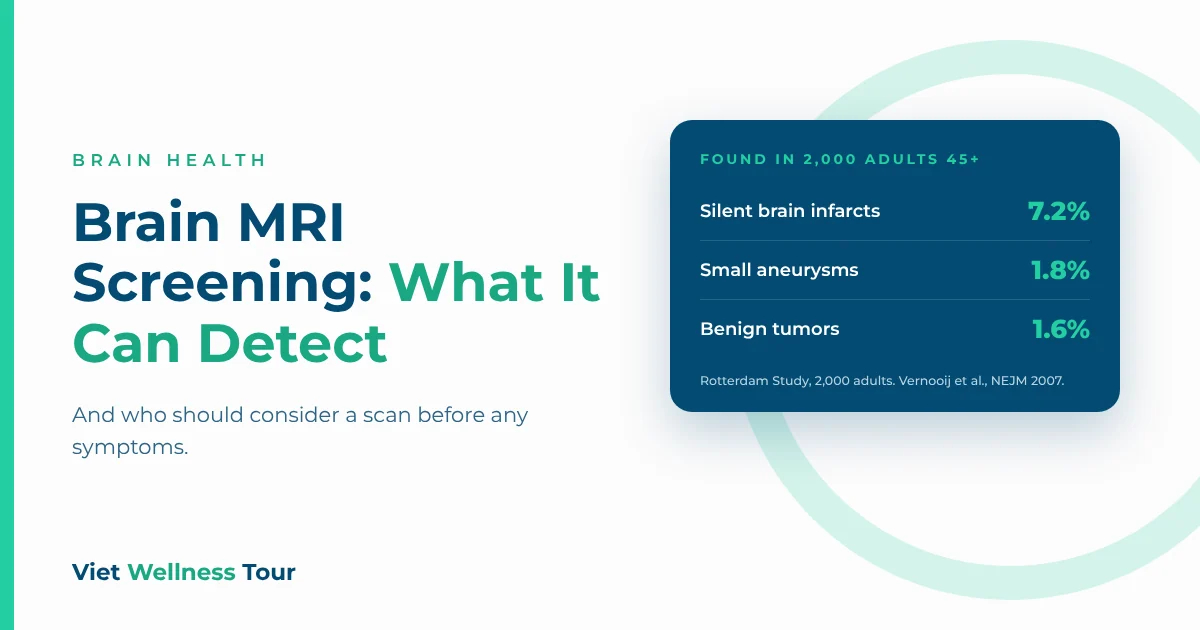
A brain MRI screening is a scan of the brain done when you don't have symptoms, to look for changes that haven't caused problems yet. In people over 45, the most common things it finds are small "silent" infarcts, small aneurysms and benign tumors (1). Most need no treatment. Some are worth knowing about early.
That's the honest summary. A brain scan check up won't tell you everything about your brain health, and it isn't the right tool if something is already wrong. But for some people, especially those with certain family histories, it answers a question nothing else can.
Screening vs Diagnosis: Two Different Reasons for a Brain MRI
Most brain MRIs are diagnostic. A doctor orders one because of a seizure, a head injury, worsening headaches or numbness that won't go away. The scan is there to explain a symptom.
Screening flips that around. There's no symptom to explain. The scan is a baseline look, and anything it finds was found by chance.
This difference matters more than it sounds. If you have new neurological symptoms, don't wait for a screening appointment. And some symptoms are emergencies. The CDC lists sudden numbness or weakness on one side, sudden confusion or trouble speaking, sudden trouble seeing in one or both eyes, sudden trouble walking and a sudden severe headache with no known cause as signs of stroke, and advises calling emergency services right away (2). In Vietnam, the ambulance number is 115.
What a Brain MRI Can Detect in People Without Symptoms
The best picture of this comes from the Rotterdam Study in the Netherlands. Researchers scanned the brains of 2,000 adults aged 45 and over from the general population, people who weren't scanned because of any symptoms, then published everything they found in the New England Journal of Medicine (1).
Here's what turned up most often:
Silent brain infarcts in 7.2% of people. These are small areas of old damage from a blocked blood vessel that never caused noticeable stroke symptoms (1).
Cerebral aneurysms in 1.8%. These are small bulges in a blood vessel wall. Most were under 7 mm (1).
Benign tumors in 1.6%, mostly meningiomas, which grow from the lining around the brain (1).
Less common findings included arachnoid cysts, which are fluid pockets that are usually harmless (1).
Pooling many studies, a 2018 meta-analysis in The BMJ put potentially serious incidental findings on brain MRI at roughly 1.4% of apparently healthy adults, with wide variation between studies (3).
So most people get a normal scan, or a scan with minor changes that come with age. A small number find something worth acting on.
Silent Brain Infarcts and White Matter Changes
Of everything a brain MRI screening can show, silent infarcts are probably the most useful to know about.
The name is a bit misleading. "Silent" means they didn't cause an obvious stroke, not that they don't matter. A 2017 scientific statement from the American Heart Association and American Stroke Association found strong evidence that silent infarcts and white matter hyperintensities (bright spots on certain MRI sequences, often linked to small vessel disease) are tied to a higher future risk of stroke, independent of other risk factors (4). The same statement says stroke prevention measures are indicated for people found to have them (4).
In practice, that usually means a closer look at the usual risk factors: blood pressure, cholesterol, blood sugar and smoking. It's a conversation to have with your own doctor, using the report as a starting point.
Worth knowing too: the same statement notes that MRI is more sensitive than CT for picking up these changes (4). Our guide on CT vs MRI for stroke screening explains why.
Brain Aneurysms and Family History
Aneurysms get the most attention, and understandably so. A ruptured aneurysm causes a serious type of bleeding around the brain.
Still, the numbers are reassuring for most people. In the Rotterdam Study, almost all the aneurysms found were small, and only one person out of 2,000 was referred for treatment of one (1).
Family history changes the picture. Guidelines from the American Heart Association and American Stroke Association say people with two or more family members who've had an intracranial aneurysm or subarachnoid hemorrhage should be offered screening, using CT or MR angiography (5). Screening may also be considered in other higher risk groups, including some people with a single affected first degree relative (5).
What a Brain MRI Screening Doesn't Do
A clear scan is good news. It isn't a guarantee.
It shows structure, not function. Memory, mood and thinking aren't measured by a picture.
It can't predict a stroke on a given day. It shows changes that are already there.
Small or early changes can be missed, and some findings stay uncertain until a follow up scan.
There's also the other side: findings that turn out to be nothing. In the BMJ review, among the potentially serious findings with a known final diagnosis, only about 1 in 5 turned out to be serious (3). Professional bodies are cautious here. In 2023, the American College of Radiology said there isn't enough evidence to recommend total body screening for people without symptoms, risk factors or a family history, partly because of unclear findings that lead to more tests (6). That statement is about whole-body scans, but the same trade-off applies to a single organ. Knowing it upfront makes the result easier to put in context. If you get a report with unfamiliar wording, How to Read Your MRI Report explains the common terms.
Who Might Consider a Brain MRI Without Symptoms
There's no single rule, and it's worth discussing with your own doctor first. People who tend to look into it include those with:
Two or more close relatives who've had a brain aneurysm or a bleed around the brain
Several stroke risk factors, such as long standing high blood pressure, diabetes or smoking
A wish for a reference scan that a future doctor can compare against
Only the first group has clear guideline support for screening (5). For everyone else, there are no trials yet showing that finding silent changes early prevents strokes (4), so it's a personal choice rather than a medical recommendation. Managing blood pressure, cholesterol, blood sugar and smoking still does far more for stroke prevention than any scan.
The scan itself is safe for most people. MRI doesn't use X-ray radiation (7), which is covered in more detail in Is MRI Radiation-Free?. Tell the team about any implants or metal in your body before booking, and mention it if you're uncomfortable in enclosed spaces (7).
If you're also wondering whether to scan more than the brain, the full-body MRI covers the brain along with the chest, abdomen, pelvis and spine in one session.
Getting a Brain MRI in Vietnam
Viet Wellness Tour arranges Brain MRI (Neuro Serenity Evaluation) screening for foreigners and overseas Vietnamese at partner hospitals in Ho Chi Minh City, Ha Noi, Da Nang and Nha Trang. The scan looks at brain tissue, white matter, the ventricles, blood vessels, the pituitary region and the cranial nerves. Ho Chi Minh City and Nha Trang offer both Standard (1.5T) and Premium (3T) machines, Da Nang offers Premium (3T) and Ha Noi offers Standard (1.5T), all on Siemens or GE scanners. Both packages include hotel transfer and an English-speaking guide on scan day.
Results arrive by email within 24 to 48 hours of the scan, subject to the hospital's reporting schedule. You'll receive the official MRI report in English, a written medical summary from the doctor and a digital copy of your images to share with your own doctor at home.
Every step is laid out on the MRI Concierge Journey page, or send the team a message to plan your visit.
Frequently Asked Questions
Can a brain MRI detect problems before symptoms? Yes, sometimes. In a study of 2,000 adults over 45, brain MRI found silent infarcts in 7.2%, small aneurysms in 1.8% and benign tumors in 1.6%. Almost none of these people had symptoms linked to what was found (1).
Should you get a brain MRI without symptoms? It depends on your risk. For people with two or more relatives who've had a brain aneurysm or bleed, guidelines support screening (5). For others, it's a personal choice best made with a doctor.
Can a brain MRI detect an aneurysm? Yes, it can. The Rotterdam Study found aneurysms in 1.8% of people scanned (1). For people with two or more relatives who've had an aneurysm or a bleed, guidelines recommend screening with CT or MR angiography (5).
Is a brain MRI safe? For most people, yes. It uses a magnet and radio waves, not X-rays (7). Some implants and devices need checking first.
Sources
Vernooij M.W. et al., "Incidental Findings on Brain MRI in the General Population", New England Journal of Medicine, 2007;357:1821-1828. https://www.nejm.org/doi/full/10.1056/NEJMoa070972
Centers for Disease Control and Prevention, "Signs and Symptoms of Stroke". https://www.cdc.gov/stroke/signs-symptoms/index.html
Gibson L.M. et al., "Potentially serious incidental findings on brain and body magnetic resonance imaging of apparently asymptomatic adults: systematic review and meta-analysis", The BMJ, 2018;363:k4577. https://www.bmj.com/content/363/bmj.k4577
Smith E.E. et al., "Prevention of Stroke in Patients With Silent Cerebrovascular Disease: A Scientific Statement From the American Heart Association/American Stroke Association", Stroke, 2017;48:e44-e71. https://www.ahajournals.org/doi/10.1161/STR.0000000000000116
Thompson B.G. et al., "Guidelines for the Management of Patients With Unruptured Intracranial Aneurysms", American Heart Association/American Stroke Association, Stroke, 2015;46:2368-2400. https://www.ahajournals.org/doi/10.1161/STR.0000000000000070
American College of Radiology, "ACR Statement on Screening Total Body MRI", April 17, 2023. https://acr.org/Media-Center/ACR-News-Releases/2023/ACR-Statement-on-Screening-Total-Body-MRI
RadiologyInfo.org (RSNA and ACR), "Magnetic Resonance Imaging (MRI) of the Head", reviewed June 15, 2026. https://www.radiologyinfo.org/en/info/headmr
Medical disclaimer: This article is for general information only and is not medical advice. If you have new or sudden neurological symptoms, seek medical care immediately. Talk to your own doctor about whether a brain MRI is right for you.
Details in this article reflect the MRI Concierge Journey process as of November 2026. Steps, packages and policies may change over time; please check with Viet Wellness Tour directly for the most current information.
VIETWELLNESS TOUR
Plan Your Full-Body MRI
Doctor-led preventive MRI screening in Ho Chi Minh City, Nha Trang, Da Nang, and Ha Noi.
- Senior radiologist-led MRI review
- Hotel pickup & English-speaking concierge
- Results in 24–48 hours + full MRI files & report
