

Why Feeling Fine Can Be Misleading
The natural belief: if nothing feels wrong, nothing is wrong
Most people judge their health based on how they feel.
If there is no pain, no unusual fatigue, and no disruption to daily life, it is natural to assume that everything is fine. In many situations, this assumption works well. Discomfort is often the body’s way of signaling that something needs attention.
Because of this, healthcare habits tend to be symptom-driven. People seek care when something feels off, and delay it when life feels normal. Feeling fine becomes a proxy for being healthy.
This belief is understandable, but it has limits.
Why the body does not always send clear warning signs
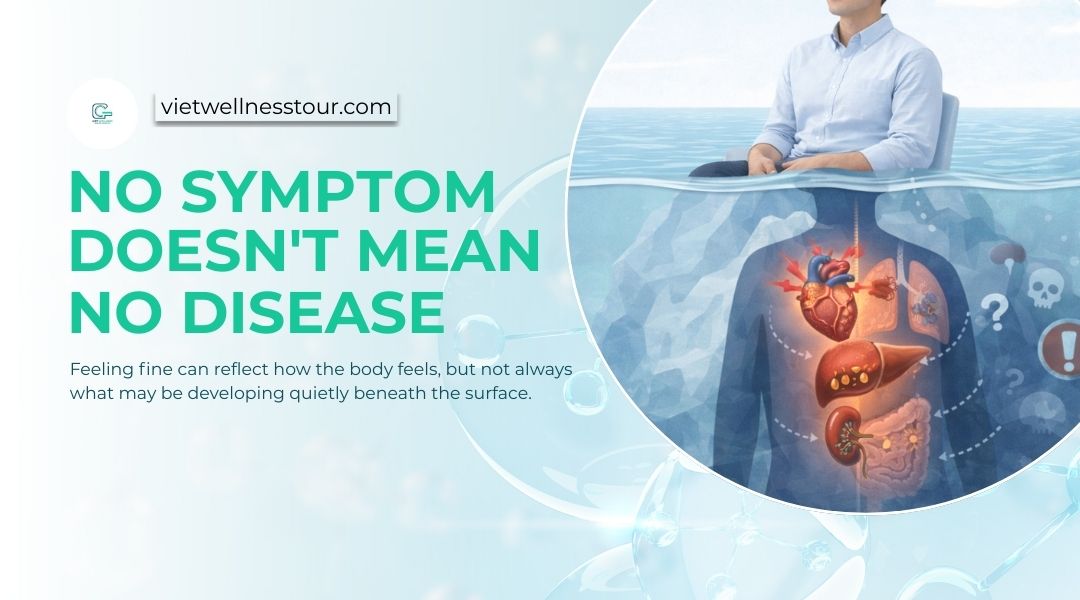
Not all health changes create immediate or noticeable symptoms.
Some processes develop gradually, without pain or obvious discomfort. The body can adapt, compensate, or mask changes for long periods of time. During this phase, a person may feel completely normal, even though something is slowly shifting beneath the surface.
This does not mean that a serious problem is already present. It means that the absence of symptoms is not a reliable signal on its own. Feeling fine reflects how the body feels at a given moment, not necessarily what is developing quietly over time.
Understanding this gap between sensation and underlying risk is an important part of preventive thinking. It explains why relying only on symptoms can leave blind spots, even in people who feel healthy and active.

How Certain Health Risks Develop Quietly
What “quiet development” actually means
When people hear that a condition can develop quietly, it is often misunderstood.
Quiet development does not mean an emergency is being missed, and it does not mean a disease is already advanced. It simply describes a period where changes are happening without creating clear, subjective signals. There is no pain to react to and no discomfort pushing someone to seek care.
In this phase, the body may still function normally. Daily routines feel unchanged, energy levels feel stable, and nothing seems urgent. From the outside, and even from personal experience, everything appears fine.
This is why quiet development is easy to overlook. Without symptoms, there is nothing to respond to.
Why absence of symptoms is not the same as absence of risk
Feeling well and being free of symptoms can be reassuring, but it is not the same as having no underlying risk.
Symptoms are signals, not guarantees. They tell us how the body feels, not everything that may be happening internally. Some risks remain invisible until they reach a point where they begin to interfere with normal function.
This does not mean that everyone without symptoms is unwell, or that hidden problems are always present. It means that relying solely on how one feels can create gaps in awareness. Preventive health thinking starts by recognizing this limitation, without turning it into fear or urgency.
Understanding that risk and sensation are not always aligned helps explain why symptom-driven care, on its own, may not be enough for people who want a clearer long-term view of their health.
The Limits of Symptom-Driven Care
When waiting for symptoms makes sense
Symptom-driven care plays an important role in healthcare.
When symptoms are sudden, intense, or clearly disruptive, they provide a strong signal that something needs attention. Pain, loss of function, or noticeable changes often guide people to seek care promptly, and in these situations, responding to symptoms is both appropriate and necessary.
This approach works well for many acute or clearly defined issues. The body sends a signal, and care follows. In these cases, symptoms serve their intended purpose.
Where symptom-driven care creates blind spots
However, symptom-driven care has natural limits.
When nothing feels wrong, there is no trigger to act. Without discomfort or disruption, it is easy to assume that no attention is needed. Over time, this can create blind spots, especially for changes that do not produce early sensations.
This does not mean that symptom-driven care is flawed. It means that it was never designed to address situations where the body remains quiet. Relying on symptoms alone can delay awareness, not because of neglect, but because there is nothing obvious to respond to.
Recognizing these limits helps explain why proactive health thinking looks beyond symptoms, without dismissing their importance.
What Screening Adds Without Replacing Diagnosis
Screening as visibility, not certainty
Screening adds a different kind of value than symptom-driven care.
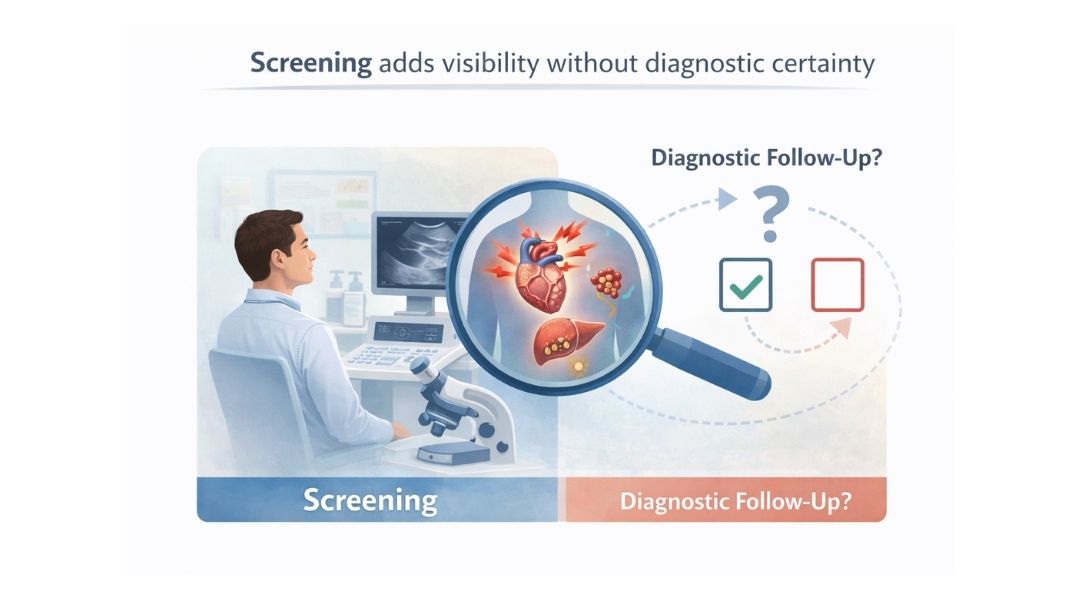
Rather than responding to a problem, screening is used to create visibility when nothing feels wrong. It helps answer a broader question: Does anything stand out that deserves attention right now? The goal is not to confirm a condition or explain symptoms, but to understand whether the overall picture appears stable or if something warrants closer observation.
Because of this, screening does not provide certainty. It does not confirm disease, and it does not rule everything out. What it offers is context. It helps reduce the unknowns that exist when decisions are based only on how one feels.
Understanding screening in this way helps prevent unrealistic expectations and reinforces why it should never be confused with diagnosis.
Two common outcomes of screening
In practice, screening usually leads to one of two outcomes.
The first is reassurance, within limits. Nothing concerning stands out at that time, and no immediate follow-up is needed. This does not guarantee that no issues will ever arise, but it provides a reference point and a clearer understanding of the present moment.
The second outcome is the identification of signals worth monitoring. These signals do not represent a diagnosis. They simply suggest that something may benefit from further attention, either now or over time. When this happens, diagnostic care and professional evaluation play an essential role in providing clarity.
Seen this way, screening supports informed awareness rather than action for its own sake.
Why This Matters for Proactive Health Planning
Reducing uncertainty rather than chasing certainty
One of the quiet benefits of preventive thinking is a better relationship with uncertainty.
Health decisions are rarely about achieving absolute certainty. Most of the time, the goal is to reduce the unknowns enough to make thoughtful, measured choices. Screening supports this by offering visibility when symptoms are absent, helping people understand where things stand rather than leaving everything to assumption.
This shift in mindset matters. Instead of reacting only when something feels wrong, people can make decisions with a clearer sense of context. The focus moves away from fear or urgency and toward understanding and planning.
Making decisions with context instead of urgency
When health decisions are driven purely by symptoms, they often arrive with pressure. Pain or disruption creates urgency, and choices must be made quickly. While this is sometimes unavoidable, it is not the only way healthcare decisions can unfold.
Proactive planning allows decisions to be made earlier and more calmly, when there is time to consider options and ask questions. Screening contributes to this process by adding information before urgency enters the picture.
This does not eliminate the need for diagnostic care when symptoms appear. It simply changes the balance, helping people move from reactive responses to more considered, long-term health thinking.
A Practical Reality for International Clients
The challenge of fragmented care across systems
For people who live, work, or travel internationally, healthcare often becomes fragmented.
Care may be spread across different countries, providers, and systems, each with its own processes and timelines. Appointments are separated by long gaps, records are not always connected, and follow-up can stretch over months. Even when nothing feels urgent, this fragmentation makes it difficult to gain a clear picture of one’s health.
In this context, relying only on symptom-driven care can add another layer of uncertainty. Without a structured approach, it is easy for important questions to remain unanswered simply because there is no obvious trigger to address them.
Why coordination matters more than volume
What matters most in these situations is not doing more tests, but having better coordination.
A well-structured screening approach can bring clarity in a single, organized setting, rather than across many disconnected visits. This does not change medical outcomes on its own, and it does not replace diagnostic care when needed. Its value lies in efficiency and coherence.
For international clients especially, this kind of coordination can reduce disruption, limit repeated appointments, and provide a clearer foundation for future decisions, regardless of where ongoing care eventually takes place.
How to Think About “No Symptoms” Going Forward
Symptoms as signals, not guarantees
Symptoms play an important role in healthcare, but they are not guarantees.
Having symptoms does not always mean something serious is present, and not having symptoms does not always mean everything is fine. Symptoms are signals that help guide attention, not definitive measures of health.
Viewing symptoms this way allows for a more balanced perspective. They remain important, but they are no longer the only lens through which health is understood.
Why thoughtful screening fits long-term health planning
Thoughtful screening fits into long-term health planning by adding perspective, not pressure.
It does not replace medical consultation, and it does not replace diagnostic care. Instead, it supports awareness when symptoms are absent and helps people approach future decisions with more context and less uncertainty.
Seen through this lens, screening becomes part of an ongoing process rather than a reaction to fear or discomfort.
Key Takeaway
Understanding that no symptoms does not always mean no disease helps shift healthcare thinking from reactive to reflective. By recognizing the limits of symptom-driven care and the role of screening, people can engage with their health in a more informed, measured way. The goal is not to eliminate uncertainty, but to manage it thoughtfully as part of long-term health planning.
FAQs – No Symptoms Doesn’t Mean No Disease
1. Can someone be healthy even if they have no symptoms?
Yes. Many people without symptoms are healthy.
However, having no symptoms only reflects how the body feels at a given moment. It does not always provide complete information about underlying risk or long-term changes. This is why absence of symptoms should be understood as one data point, not a final conclusion.
2. Why do some health conditions develop without noticeable symptoms?
Some changes develop gradually or do not interfere with normal function at first. The body can adapt or compensate, which means there may be no pain or discomfort to signal that something is changing. This quiet phase can last for a long time without creating obvious signs.
3. Does feeling fine mean there is nothing to worry about?
Feeling fine can be reassuring, but it does not guarantee that there are no health risks. It simply means that no symptoms are present. Understanding this distinction helps set realistic expectations without creating unnecessary concern.
4. Is symptom-driven care enough for long-term health planning?
Symptom-driven care is essential when problems arise, but on its own it may leave gaps in awareness when the body remains quiet. Long-term health planning often benefits from understanding both symptoms and underlying risk, rather than relying on symptoms alone.
5. Does the absence of symptoms mean screening is unnecessary?
Not necessarily. Screening and diagnostic care serve different purposes. Screening is used when symptoms are absent to provide general visibility, while diagnostic care is used to investigate specific concerns. The absence of symptoms does not automatically determine whether screening is appropriate.
6. Can screening detect problems before symptoms appear?
Screening can sometimes highlight signals that deserve attention before symptoms are noticed. It does not confirm disease or predict outcomes. Its role is to improve awareness, not to provide certainty.
7. If screening results are normal, does that mean everything is fine?
Normal screening results indicate that nothing concerning was identified at that time, within the limits of the screening method used. They do not guarantee that no issues exist or will develop in the future. Screening reflects a snapshot, not a lifetime assessment.
8. Why might screening lead to further evaluation even without symptoms?
If screening identifies something that requires clarification, further evaluation may be suggested to better understand the finding. This does not mean a condition is confirmed. It reflects the stepwise nature of healthcare decision-making.
9. How should symptoms and screening be viewed together?
Symptoms and screening provide different types of information. Symptoms reflect how the body feels, while screening provides broader context. Viewing them together helps create a more balanced understanding of health over time.
10. What is the main takeaway for people who feel healthy?
Feeling healthy is important and meaningful. At the same time, it should not be treated as definitive proof that no risks exist. Thoughtful health planning recognizes both the value and the limits of symptoms, without turning awareness into fear.
VIETWELLNESS TOUR
Plan Your Full-Body MRI
Doctor-led preventive MRI screening in Ho Chi Minh City, Nha Trang, Da Nang, and Ha Noi.
- Senior radiologist-led MRI review
- Hotel pickup & English-speaking concierge
- Results within 24 hours + full MRI files & report
