



TL;DR
Screening and diagnostic care serve different purposes and are used at different times.
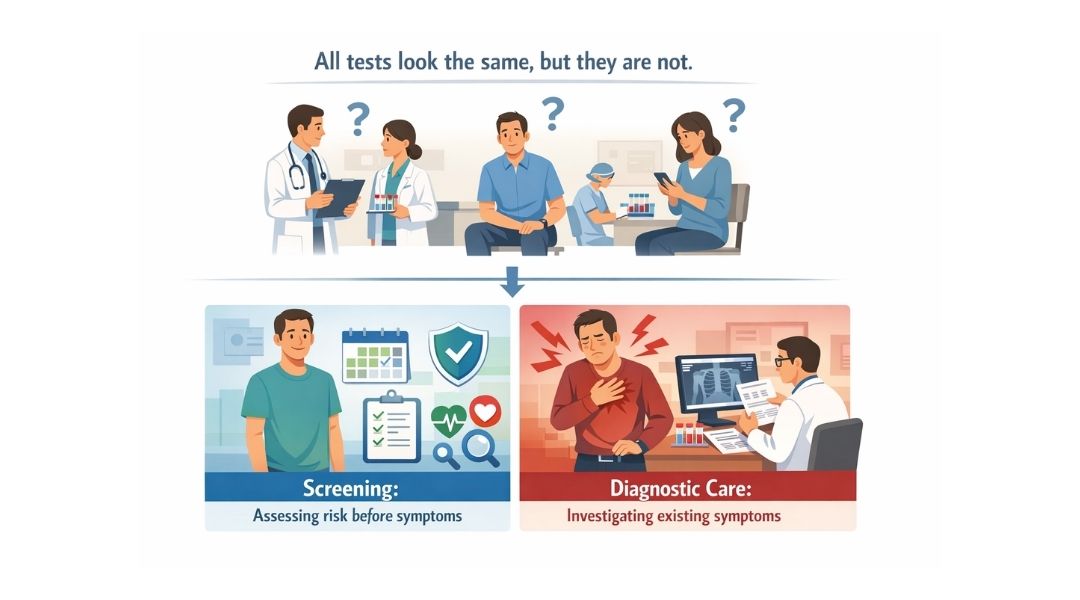
Screening is used when no symptoms are present, to increase awareness and identify potential signals.
Diagnostic care is used when symptoms or concerns already exist, to investigate and clarify their cause.
Screening does not provide definitive answers, and diagnostic care does not work without clinical context.
Understanding this distinction helps set realistic expectations and supports more thoughtful, preventive health decisions over time.
I. Why Screening and Diagnostic Care Are Often Confused
The common assumption: all medical tests serve the same purpose
For many people, healthcare feels simple on the surface.
You visit a clinic, a test is ordered, and you wait for results.
Because of this, it is easy to assume that all medical tests exist for the same reason. A scan, a blood test, or an imaging exam can appear interchangeable. If a test is done, it must be looking for a problem. If nothing is found, everything must be fine.
This way of thinking is understandable, but it misses an important distinction. Not every test is meant to confirm a disease. Some are designed to explore symptoms that already exist, while others are meant to assess risk before anything feels wrong.
When that difference is unclear, expectations can become mismatched. People may expect certainty from a process that was never designed to provide it, or delay care because they believe a past test has already “ruled everything out.”
How healthcare language adds to the confusion
Healthcare terminology often makes this misunderstanding worse.
Words like “check-up,” “screening,” “scan,” or “testing” are frequently used without explanation. In everyday conversations, they are treated as neutral actions rather than tools with specific purposes. Media articles and online discussions also tend to simplify language to make it more accessible, sometimes at the cost of precision.
As a result, screening and diagnostic care are often grouped together under the same umbrella, even though they are used at very different moments in a person’s health journey.
Without clear language, people may not realize that timing, context, and intent matter just as much as the test itself. Understanding this distinction is the first step toward clearer expectations and more informed conversations with healthcare professionals.
II. What Screening Care Is Designed to Do
Screening starts before symptoms appear
Screening is used at a very different moment than diagnostic care.
It begins when a person feels well, functions normally, and does not have a specific complaint to explain. There is no pain to investigate and no symptom pointing toward a particular condition. Instead, the question is more general: Is there anything developing quietly that I should be aware of?
Because of this, screening is not meant to provide certainty or conclusions. It looks for signals that suggest whether further attention might be needed, not answers that confirm a diagnosis. In many cases, screening results are normal, and no further steps are required. In other cases, they raise questions rather than resolve them.
Understanding this purpose helps prevent disappointment or confusion. Screening is about awareness and early insight, not definitive answers.
The role of screening in long-term health planning
One way to think about screening is as a tool for orientation.
It helps establish a general picture at a point in time, especially when no symptoms are present. This can be useful for understanding personal risk factors, setting a baseline, or deciding what deserves closer observation over time.
Importantly, screening does not replace medical judgment or ongoing care. Its value lies in supporting thoughtful planning, not in directing immediate action. When used appropriately, it can help people avoid both unnecessary alarm and unnecessary delay.
Seen this way, screening plays a quiet but important role in preventive health. It does not predict the future, but it can inform how people stay attentive to their health as life continues.
III. What Diagnostic Care Is Designed to Do
Diagnostic care begins with a complaint or concern
Diagnostic care starts from a different place entirely.
It is initiated when something feels wrong. A new symptom appears, an existing issue worsens, or a change interferes with daily life. Pain, dizziness, weakness, persistent fatigue, or other noticeable changes create a clear reason to investigate.
In this context, tests are not exploratory. They are targeted. Diagnostic care asks a specific question and looks for an explanation that fits the clinical picture. The goal is not general awareness, but clarification.
This is why diagnostic care is closely tied to clinical evaluation. Symptoms provide context, and that context shapes what tests are appropriate and how results are interpreted.
Why diagnostic care is essential when symptoms exist
When symptoms are present, screening alone is not enough.
Screening tools are not designed to explain active problems, and relying on them in place of diagnostic evaluation can create false reassurance or delay proper care. Diagnostic care exists to address exactly these situations, where timely understanding matters.
Equally important, diagnostic tests do not stand on their own. Results gain meaning only when considered alongside medical history, physical examination, and professional judgment. A finding that is insignificant in one context may be important in another.
This is why diagnostic care plays a critical role in healthcare. It responds to problems that are already affecting a person’s life and helps guide appropriate medical decisions under professional supervision.
IV. How Screening and Diagnostic Care Work Together
Screening does not replace diagnostic care
One of the most important points to understand is that screening and diagnostic care are not substitutes for each other.
Screening is designed to look broadly, often in the absence of symptoms. Diagnostic care is designed to look closely, in response to specific concerns. Because their purposes are different, the information they provide serves different roles.
A screening result, even when it raises a question, does not confirm or rule out a condition. It simply suggests whether further evaluation might be appropriate. Diagnostic care is what provides clarity when a health issue needs to be understood in detail.
Keeping this boundary clear helps prevent unrealistic expectations and reduces the risk of misinterpreting results.
A stepwise approach to healthcare decisions
Together, screening and diagnostic care form a stepwise approach to health.
Screening can support awareness and early insight when people feel well. Diagnostic care becomes essential when symptoms appear or when screening findings need further explanation. Each step builds on the other, guided by context rather than urgency.
This approach allows healthcare decisions to be more measured. It reduces the likelihood of unnecessary testing on one end and delayed evaluation on the other. Most importantly, it reinforces the idea that tests are tools within a broader process, not answers in themselves.
Understanding how these two forms of care interact helps people engage with healthcare more thoughtfully, with clearer expectations and less confusion.

V. Important Limitations to Understand
Screening can raise questions, not provide final answers
One limitation that is often overlooked is that screening results are rarely definitive.
Because screening looks broadly and often without symptoms, findings can be unclear, non-specific, or difficult to interpret on their own. A result may indicate that something deserves attention, but it does not explain what that finding means in a clinical sense.
This is not a flaw. It reflects the purpose of screening. It is meant to highlight possibilities, not to resolve them. Expecting certainty from screening can lead to unnecessary anxiety or misplaced reassurance, depending on how results are interpreted.
Recognizing this limitation helps set realistic expectations and reinforces the importance of professional interpretation when questions arise.
Diagnostic care depends on clinical context
Diagnostic care also has limitations, even though it is more targeted.
Tests used in diagnostic settings are guided by symptoms, history, and examination. Without that context, results lose much of their meaning. A test does not make a decision on its own, and it does not replace clinical judgment.
This is why diagnostic care is not simply about ordering the “right” test. It is about understanding how findings fit into a broader picture that includes the individual’s experience, risk factors, and overall health.
Being aware of these limitations on both sides helps people understand that healthcare decisions are rarely based on a single result. They are built through careful evaluation over time.
VI. How to Think About Screening and Diagnostic Care
Asking the right questions at the right time
A helpful way to approach healthcare is to focus less on specific tests and more on purpose.
Before any test is considered, it can be useful to ask what question is being explored. Is the goal to understand general health risk when nothing feels wrong, or to explain a symptom that is already affecting daily life? The answer to that question determines whether screening or diagnostic care is appropriate.
Thinking this way helps align expectations with reality. It reduces frustration when screening does not deliver certainty and reinforces the importance of diagnostic care when symptoms are present. Most importantly, it encourages people to see tests as part of a broader process rather than isolated solutions.
Why professional guidance remains essential
Both screening and diagnostic care rely on professional interpretation.
Results do not exist in isolation, and their meaning depends on context, experience, and clinical judgment. This is especially important in preventive health, where decisions are often less urgent but more nuanced.
Understanding the difference between screening and diagnostic care supports better conversations with healthcare providers. It allows people to ask clearer questions, interpret information more calmly, and participate more thoughtfully in decisions about their health.
VII. Why This Distinction Matters for Preventive Health
When screening and diagnostic care are clearly understood, healthcare becomes less reactive and less confusing.
People are less likely to seek certainty from tools that are not designed to provide it, and less likely to delay evaluation when symptoms appear. Expectations become more realistic, and decisions become more grounded.
Preventive health is not about constant testing or avoiding illness at all costs. It is about understanding risk, recognizing change, and responding appropriately over time. Knowing how screening and diagnostic care differ is a small but important part of that understanding.
This distinction helps explain why many proactive individuals think about healthcare as an ongoing process rather than a single event. Screening and diagnostic care each have their place, and when they are used with clear intent and professional guidance, they support more thoughtful, responsible health planning.
VIII. FAQs – Screening vs Diagnostic Care
1. What is the primary difference between screening and diagnostic tests?
The main difference lies in purpose and timing.
Screening tests are used when a person has no symptoms, with the goal of identifying potential risks or early signals that may deserve attention. Diagnostic tests are used when symptoms or specific concerns already exist, and their purpose is to investigate and clarify the cause of those symptoms. Both play important but different roles in healthcare.
2. Is screening the same as preventive care?
Screening is one part of preventive care, but the two are not the same.
Preventive care is a broader concept that includes lifestyle guidance, routine health assessments, vaccinations, and ongoing monitoring. Screening refers specifically to tests or evaluations designed to look for potential health risks before symptoms appear.
3. Who typically undergoes screening, and who usually needs diagnostic care?
Screening is generally used by people who feel well and do not have specific symptoms but want to understand their health risks. Diagnostic care is typically used when someone experiences symptoms, changes, or concerns that need medical explanation. The distinction depends more on clinical context than on age or personal preference.
4. Can a screening test provide a definitive diagnosis?
No. Screening tests are not designed to provide a definitive diagnosis.
They may indicate whether further evaluation could be helpful, but confirmation or exclusion of a medical condition requires diagnostic assessment and professional interpretation.
5. If a test is ordered because of symptoms, is it still considered screening?
When a test is ordered to investigate symptoms, it is generally considered part of diagnostic care, even if the test itself is commonly used in screening settings. The classification depends on medical intent, not on the name of the test.
6. Does a family history change how screening and diagnostic care are used?
Family history can influence how healthcare professionals think about risk and monitoring, but it does not automatically change screening into diagnostic care. Screening may still be used in people without symptoms, even when risk factors are present. Diagnostic care is typically driven by symptoms or specific clinical findings.
7. What usually happens after a screening result raises a concern?
When a screening result raises a concern, it often leads to further evaluation, which may include diagnostic tests or professional consultation. This does not mean that a condition is confirmed. It simply reflects the role of screening as a signal for closer examination rather than a final answer.
8. Does a normal screening result mean there are no health issues?
A normal screening result means that no concerning signals were detected at that time, within the limits of the screening method used. It does not guarantee that no health issues exist or will develop. Screening reflects a moment in time and should be understood within its limitations.
9. Why are screening results sometimes followed by diagnostic tests?
Screening and diagnostic tests serve different purposes. When screening identifies something that deserves clarification, diagnostic tests may be used to better understand what is happening. This sequence reflects a stepwise approach rather than a problem with the screening itself.
10. How do screening and diagnostic care fit into a long-term health approach?
Together, screening and diagnostic care support a more thoughtful approach to health over time. Screening helps with awareness and early insight when people feel well. Diagnostic care provides clarity when symptoms or concerns arise. Understanding how they complement each other can lead to more realistic expectations and better-informed discussions with healthcare professionals.
VIETWELLNESS TOUR
Plan Your Full-Body MRI
Doctor-led preventive MRI screening in Ho Chi Minh City, Nha Trang, Da Nang, and Ha Noi.
- Senior radiologist-led MRI review
- Hotel pickup & English-speaking concierge
- Results within 24 hours + full MRI files & report
