


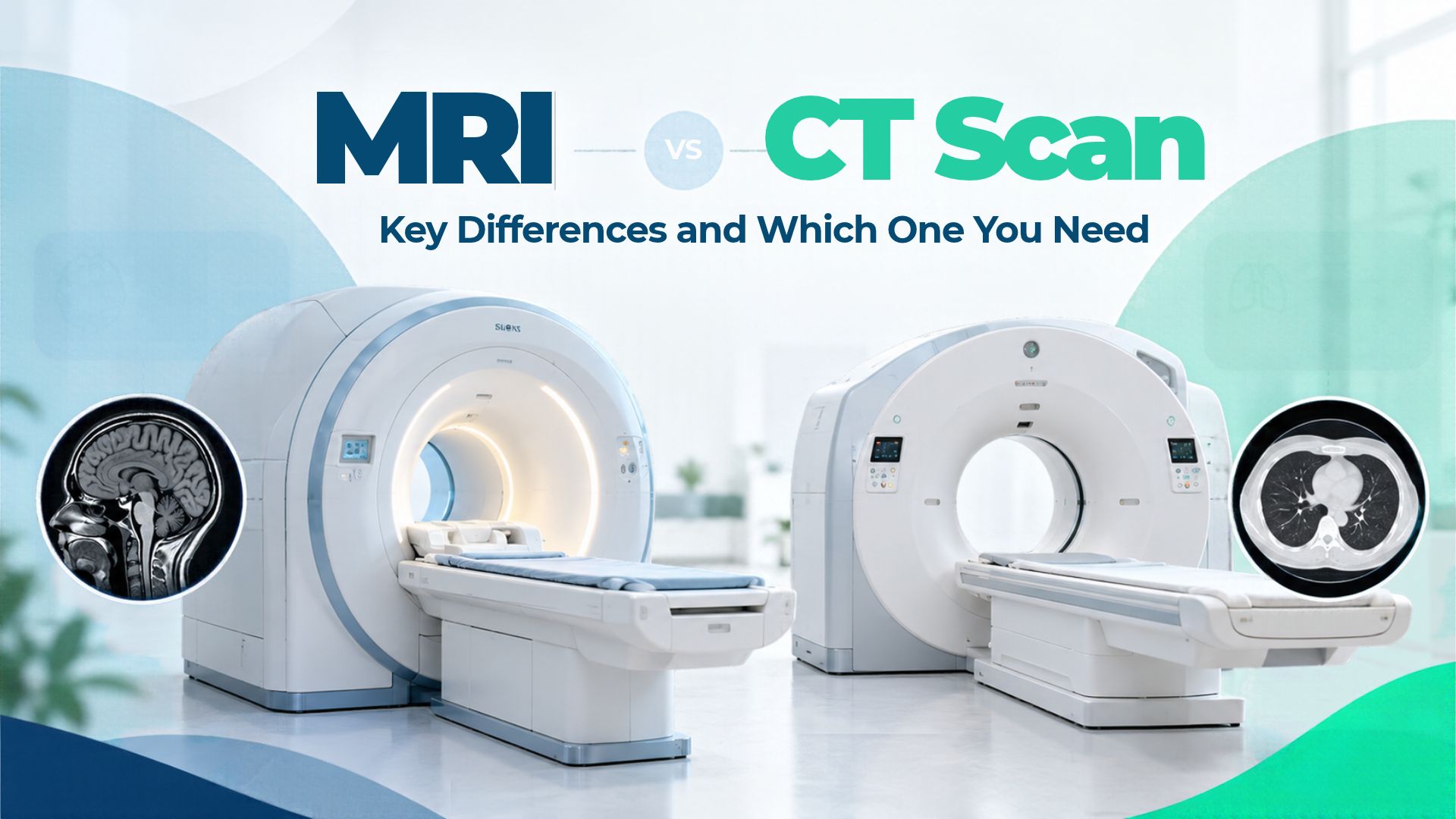
A CT scan uses X-rays and is over in a few minutes. An MRI uses a strong magnet and radio waves, takes longer, and involves no ionizing radiation (1)(2). CT is usually the first choice in emergencies and for bone, lungs and bleeding, while MRI tends to show soft tissue such as the brain, spinal cord, muscles and ligaments in finer detail (1)(2). So which one is "better" really depends on what your doctor needs to see.
If you've been told you need "a scan" and aren't sure which kind, you're not alone. The two machines even look a little alike. But how they work, and what each one can see, is quite different.
How a CT Scan Works
CT stands for computed tomography. You may also hear it called a CAT scan. So if you're wondering about the difference between an MRI and a CAT scan, it's the same comparison: CAT is just an older name for CT (3). An X-ray source rotates around you while a computer builds cross sectional images of the area being checked.
The scan itself usually takes less than five minutes (3). Like a regular X-ray, it uses a small amount of ionizing radiation (3).
How an MRI Scan Works
MRI stands for magnetic resonance imaging. Instead of X-rays, it uses a powerful magnetic field and radio pulses. The magnet lines up protons in the water inside your body, the radio pulses knock them out of line, and the scanner picks up the signal they give off as they settle back (2).
Because no X-rays are involved, MRI doesn't expose you to ionizing radiation (2). The trade off is time. A typical scan runs from 15 minutes to an hour, sometimes longer, and the machine is loud, so you'll be given earplugs or headphones (6).
MRI vs CT Scan at a Glance
MRI | CT (CAT) scan | |
|---|---|---|
How it works | Magnetic field and radio waves (2) | X-rays and a computer (1) |
Ionizing radiation | None (2) | Small amount (3) |
Scan time | 15 to 60 minutes, sometimes longer (6) | Usually under 5 minutes (3) |
Best at | Soft tissue: brain, spinal cord, muscles, ligaments (2) | Bleeding, fractures, lungs, fast emergency checks (1)(3) |
Cost | Usually higher (2)(8) | Usually lower (1) |
Metal implants | Some implants rule it out (2) | Usually possible; tell staff about any implant |
What Is the Difference Between MRI and CT in Practice?
Speed and availability are the big practical gaps. Mayo Clinic notes that CT is often the first test because it's fast, widely available and less expensive than MRI (1). In an emergency room, that speed matters.
MRI's advantage is detail. Using the brain as an example, CT can quickly find bleeding, swelling, fractures or irregular growths. MRI, on the other hand, gives more detailed images of brain tissue, which helps with tumors, dementia and acute ischemic stroke (1). If stroke is your main concern, our guide to CT vs MRI for stroke screening goes deeper.
How Much Radiation Does a CT Scan Involve?
The average person in the US gets about 3 mSv a year from natural background radiation (4). For comparison, RadiologyInfo lists typical adult CT doses like these (4):
CT of the brain: 1.6 mSv, roughly 7 months of background radiation
CT of the chest: 6.1 mSv, roughly 2 years
CT of the abdomen and pelvis: 7.7 mSv, roughly 2.6 years
The FDA estimates that a 10 mSv exam may add about 1 chance in 2,000 of fatal cancer, on top of a natural lifetime risk of about 1 in 5 (5). The US National Cancer Institute puts it simply: the added risk from one CT scan is still small, and the benefit usually outweighs it when the scan is medically needed (7).
So a CT your doctor recommends isn't something to avoid. Radiation is mainly why MRI gets chosen for repeat imaging and for screening people who feel well. More on that in Is MRI Radiation-Free?
Which Is Better, MRI or CT Scan?
There's no single answer. It depends on what needs to be seen. CT is usually the better fit for:
Emergencies, where speed comes first (1)
Suspected internal bleeding or brain injury (1)(3)
Broken bones (3)
Lung problems such as pneumonia and emphysema (3)
MRI is usually the better fit for:
The brain and spinal cord (2)
Muscles, ligaments and other soft tissue (2)
Problems that bone can hide on other tests (8)
Situations where avoiding radiation matters, such as repeat scans (2)
There are practical limits too. People with certain implants, especially ones containing iron such as some pacemakers and cochlear implants, may not be able to have an MRI (2). You'll need to lie still for a while, and even mild claustrophobia can make long scans hard (2). Always tell the team about any implant before booking.
MRI Alternatives Worth Knowing
If MRI isn't possible for you, CT is the most common substitute. Your doctor may also suggest ultrasound or another test that doesn't involve radiation, and it's a fair question to ask (7). If claustrophobia is the worry, mention it before booking so the hospital can plan around it.
Getting an MRI or CT Scan in Vietnam as a Foreigner
If you're living in Vietnam or visiting for a few weeks, the scan itself is the easy part. The admin around it is where things tend to go wrong. A few things help:
Know what's being asked for. Note which scan and which body area your doctor wants. If you have a referral letter or older scans and reports from home, bring them so the radiologist can compare.
Mention implants early. Tell staff about any pacemaker, implant, metal fragment or possible pregnancy before booking, not on the day.
Ask about contrast and fasting. Some scans use a contrast dye and need a few hours without food.
Ask for the report in English. Also ask for a full digital copy of your images, so your doctor at home can review them.
Plan around result times. Leave enough time in the city to receive your results before you move on.
Language is the step most visitors underestimate. Booking, filling in safety forms and reading the final report all go far more smoothly with someone who speaks both English and Vietnamese.
Where MRI Fits in Preventive Screening
CT does have proven screening uses. Low dose CT is recommended yearly for lung cancer screening in adults aged 50 to 80 who are at increased risk (7).
Whole body screening is a different story, and it's worth being straight about it. The American College of Radiology says there isn't yet enough evidence to recommend total body screening for people with no symptoms, risk factors or family history pointing to a problem (9). Any scan can also turn up incidental findings that lead to extra tests (5).
That doesn't make screening the wrong call for everyone. Some people choose it because of a family history, or simply for peace of mind. When they do, MRI is the usual choice because it involves no radiation (2). What matters is going in with realistic expectations and having a qualified radiologist read the results. Our guide to whole body MRI in Vietnam covers what it can and can't show.
Viet Wellness Tour arranges MRI for international visitors and expats in Ho Chi Minh City, Hanoi, Da Nang and Nha Trang, including brain MRI, spine MRI and full body MRI. An English speaking guide meets you at an agreed meeting point and takes you to the clinic. A radiologist reads your scan, and results usually arrive within 24 to 48 hours of the scan, depending on the hospital's schedule, with an English report sent by email. You can choose a Standard package on a 1.5T machine or a Premium package on a 3T machine.
Weighing an MRI during your time in Vietnam? See how it works on the MRI Concierge Journey page, or message our team with your questions.
FAQ
Is a CAT scan the same as a CT scan?
Yes. CAT stands for computed axial tomography, an older name for the same test (3).
What's the main difference between an MRI and a CT scan?
CT uses X-rays and takes a few minutes. MRI uses a magnetic field and radio waves, takes longer and involves no ionizing radiation (1)(2)(3).
Which is better, MRI or CT scan?
It depends on the question being asked. CT is faster and suits emergencies, bleeding, bones and lungs. MRI gives more detail of soft tissue such as the brain and spinal cord (1)(2).
Why would a doctor order a CT instead of an MRI?
CT is fast, widely available and usually cheaper, so it's often the first test, especially in an emergency (1).
Is an MRI safer than a CT scan?
MRI doesn't use ionizing radiation (2). It isn't suitable for everyone, though: some metal implants rule it out, and people with claustrophobia may find longer scans difficult (2).
How long does each scan take?
The CT scan itself usually takes under five minutes (3). An MRI usually takes 15 minutes to an hour (6).
Disclaimer and Sources
This article is for general information only and isn't medical advice. Which scan is right for you depends on your health history, so please talk to a doctor before making decisions about imaging.
Information valid as of November 2026 and may change.
Sources
Mayo Clinic: What's the difference between a brain CT scan and a brain MRI?
NIBIB (US National Institutes of Health): Magnetic Resonance Imaging (MRI)
National Cancer Institute: Computed Tomography (CT) Scans and Cancer Fact Sheet
RadiologyInfo.org: Magnetic Resonance Imaging (MRI) of the Body
American College of Radiology: ACR Statement on Screening Total Body MRI (April 2023)
VIETWELLNESS TOUR
Plan Your Full-Body MRI
Doctor-led preventive MRI screening in Ho Chi Minh City, Nha Trang, Da Nang, and Ha Noi.
- Senior radiologist-led MRI review
- Hotel pickup & English-speaking concierge
- Results in 24–48 hours + full MRI files & report
